
US rate rise this week now almost fully priced. Key is further Fed expectations which continue to rise on the back of oil prices and the realisation that the AI investment phase is near-term inflationary. RBA to remain hawkish.
Key points
- Bond yields and interest rate expectations jumped sharply over the past week. This reflected a combination of a sharp rise in oil prices, the higher than expected US core CPI for August and related repricing of short-end expectations, President Trump’s contingent promise of a very large fiscal boost if he wins the mid-term elections, and continuing concern over the funding needs of governments and AI.
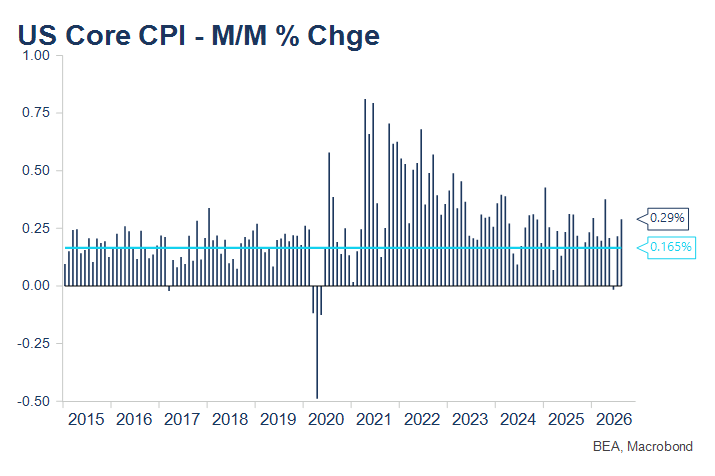
- The August US core CPI wasn’t quite as bad as it appeared, with around one third of the +0.3% m/m gain coming from cellular phone plan increases that won’t repeat in September. But it was still enough to see most economists now view a Fed rate rise on Wednesday as a done deal. The market is now just under 90% priced.
- The more important question is what happens after Wednesday? It seems likely that the recent renewed rise in oil prices and the short-term inflationary consequences of the AI investment boom are likely to continue to frustrate central banks’ attempts to return inflation to target. This has been behind my view that interest rates would continue to rise slowly and further than markets expected, with no early interest rate cuts likely. That view remains on track at this stage.
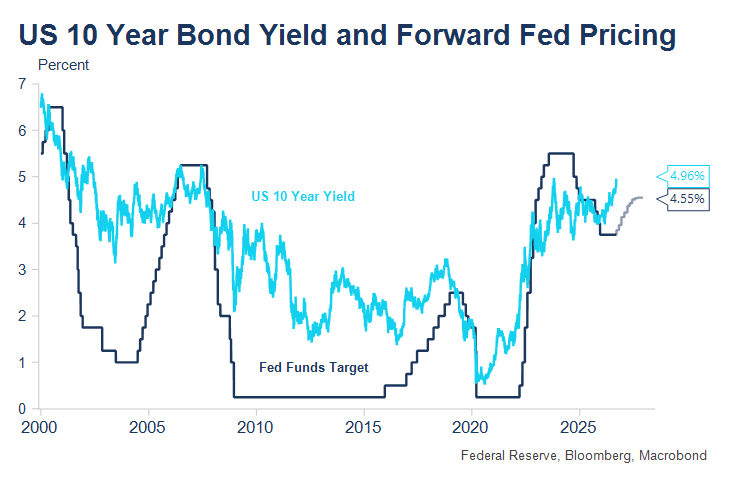
- The US 10-year bond yield often peaks close to what subsequently turns out to be the peak in the US cash rate. The recent shift in long bond yields perhaps signals the Fed will require a cash rate closer to 5% to return inflation to target. My thinking is that 75 basis points of tightening will likely be sufficient for the next phase of tightening, with a second increase to be delivered before Christmas (this now priced).
- In both Australia and the US, the calendar is very light for economic data this week (Australia nothing of note, the US Retail Sales and Industrial Production and Capacity Utilisation, the latter a useful indicator of the pressures associated with the AI boom).
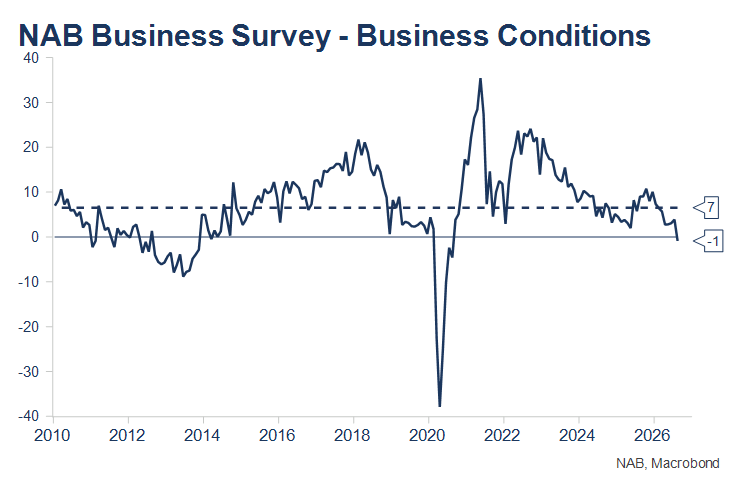
- The focus will therefore be on central banks. There are five separate appearances from RBA staff over the next two weeks – and two this week. It would surprise if the very hawkish inflation messages of the past week from Deputy Governor Hauser and Assistant Governor Hunter did not continue. These signal a very likely September Australian interest rate rise (now 80% priced). The weaker NAB Survey last week argues against the likelihood of a quick follow-up rate rise.
- In the US, market focus will be on whether the median forecaster sees an additional rate rise before the end of 2026 and how the median views the likely path of interest rates next year. Only one rise was foreshadowed in the June Summary of Economic Projections, leaving plenty of room for change, though there are still influential members on the Committee that were detecting a moderation in inflation before the August CPI result. Also in focus will be the US unemployment projections, previously seen at 4.3% (end 2026 and end 2027).
Key developments over the past week
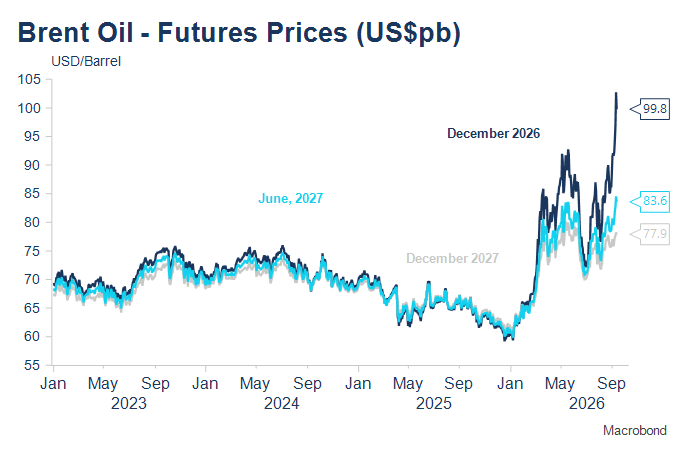
The past week saw a further sharp rise in US and Australian bond yields. This primarily reflected a surge in oil prices as renewed hostilities broke out in the Middle East with Brent rising over US$10pb (or around 12% over the week). December 2026 futures traded to new highs as the market either reflected reduced optimism of any near-term resolution or a likely more significant and perhaps somewhat more non-linear reaction for oil prices given the continuing closure of the Strait of Hormuz.
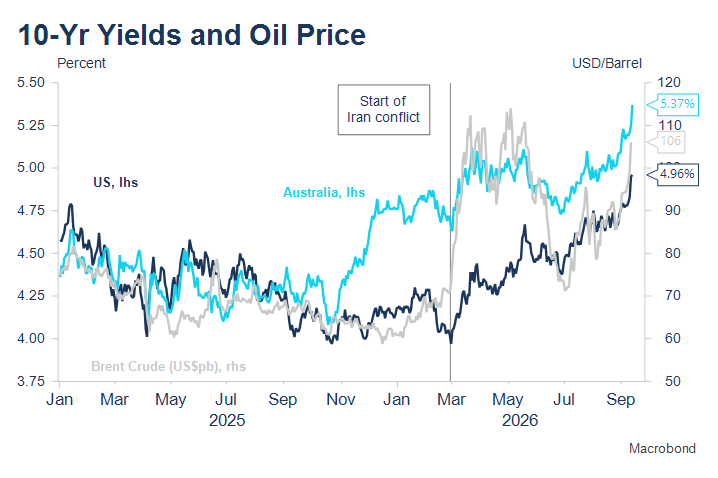
More confident pricing of an interest rate rise by the Federal Reserve at this Wednesday’s Meeting, a $5000 cheque for each adult American if Trump wins the mid-terms and the continuing realisation that the short-term effect of the AI investment phase will be inflationary, all contributed to the rise. The rise in oil prices however appears to have been the most significant development, pressuring Australian and US bond yields sharply higher.
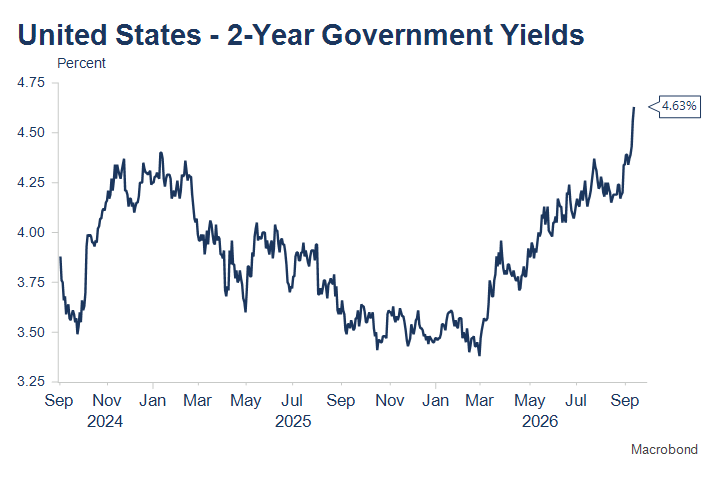
The higher-than-expected August US core CPI reading of +0.3% m/m also saw almost all US economists now forecasting a US interest rate rise this week. A rise in mobile phone charge plans that won’t re-occur in September accounted for around one third of the rise in the core measure this month, slightly lessening the strength of the signal of the print. However, the general rate of price increase remains well above that of the 0.165% m/m rate required to annualise at 2%. Energy prices and AI-related impacts on selected commodities, construction costs and technology components seem increasingly likely to boost CPI readings in coming months, frustrating the Fed’s attempts to return inflation to target.
In Australia, the key development was very hawkish remarks midweek on inflation from RBA Deputy Governor Hauser that suggest RBA staff will recommend a further tightening of monetary policy at the late September board meeting as inflation risks increasingly become reality rather than are prospective. At the same time, the NAB Business Survey recorded its first negative print since the pandemic as higher fuel prices in particular impacted on business profitability. That softer print is behind my expectation that a very near-term follow up interest rate rise in Australia is less likely than in the US, especially as the RBA has already raised interest rates three times this year.
What’s priced in
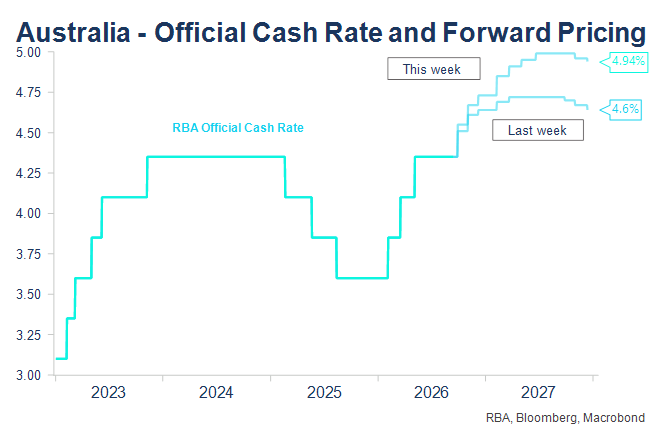
Developments over the past week have seen Australian and US interest rate markets add more than a full 25bps tightening to the forward path of interest rates. The Australian market is 80% priced for a rate rise in September (I continue to think this is highly likely), with a second increase priced for the RBA’s February meeting, and two and a half interest rate rises by mid-2027. My base case remains of a long, slow tightening cycle, reflecting the AI investment boom, with no early interest rate cuts, though the NAB Survey cautions against expecting back-to-back interest rate rises. That said, I wonder whether Deputy Governor Hauser’s comments about people being “furious about inflation” reflect his frustration with a slow moving Monetary Policy Board or a potential shift to a more aggressive short-term posture?
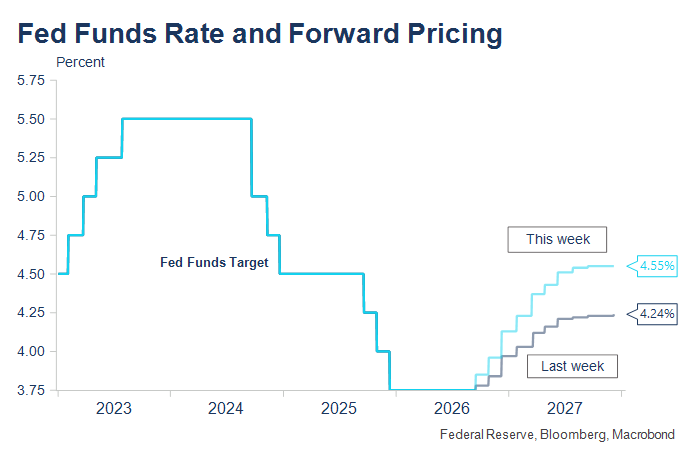
In the US the recent repricing of short-term interest rates has been substantial, with the market only just over 50% priced for a September interest rate rise this time last week. Now a near 90% probability is attached, two moves are discounted by Christmas (my base case), three by March, and a peak cash rate of over 4.5% in the second half of next year. The latter implies three and a half interest rate rises, fully reversing the rate cuts of 2025.
Outlook
Bond yields continue to rise reflecting a combination of:
- Rising Japanese bond yields (an underappreciated factor, with Japanese bond yields having been an anchor for longer-dated bond yields around the world for many years).
- Higher inflation, given the renewed sharp rise in oil prices in recent weeks as the situation deteriorates again in the Middle East.
- Markets price in higher short-term interest rates reflecting higher energy prices and the additional short-term inflationary pressure from the investment phase of the AI boom.
- The large demand for funds from continuing large US budget deficits and AI investment. Interest rates typically rise further and for longer than expected during investment booms.
As noted in previous weeklies, it’s a very complex environment in markets, with a large number of moving pieces. Oil price developments are having the biggest near-term effects on markets, though the inflationary and funding impacts of the AI investment boom are also gradually filtering into market and central bank think. This has been a relatively new development.
My former colleague Peter Jolly often noted that the US ten-year bond yield tends to peak around but ahead of the peak level for the Fed funds rate. The recent rise in 10-year yields suggests the fed funds rate may peak closer to 5%. I continue to expect a long, slow tightening cycle – similar to previous investment booms – though markets will have to trade the ups and downs of oil prices around that trend, as they have been doing for over six months. Long end yields will also have to factor prospectively much stronger productivity growth as the AI investment phase matures.
Australian and US key events calendar
Again, it’s a relatively quiet week for economic data in both the US and Australia. Central bank communications and actions will be the focus of markets as a result. While a tightening in both markets in September is now relatively fully priced, bond markets are unlikely to respond favourably if the Fed fails to tighten early Thursday morning, Australian time.
In Australia, with no significant economic data due, focus will be on two RBA appearances, one Monday at lunchtime and the second, the six-monthly Semi-Annual Testimony to Parliament on Friday morning. It would be a big surprise if the recent hawkish messages on inflation did not continue.
In the US, the only data of note are Retail Sales and Industrial Production and Capacity Utilisation. The cap use measure may increasingly receive greater focus as an indicator of the inflationary pressures being generated by the AI investment boom. The Retail Sales headline figures should be boosted by higher oil prices so the aggregates excluding oil and gas and the control figures should be focused on. Some bounce back is expected – and seems likely – after last month’s softish results.
All times shown are AEST.
Monday 14 September
- 12:30pm RBA’s Hunter Fireside Chat
Tuesday 15 September
- 12:00pm China Retail Sales, Fixed Asset Investment, Industrial Production and Unemployment (August)
Wednesday 16 September
- 11:00am $1bn 3.75% 2037 bond tender
- 10:30pm US Retail Sales (August) (Control expected +0.4% m/m, previous -0.4% m/m; ex autos and gas expected +0.4% m/m, previous -0.2% m/m).
Thursday 17 September
- 04:00am FOMC Decision (25 bps rate increase expected)
- 04:30am Fed Chair Warsh Press Conference
- 08:45am NZ GDP (Q2)
- 09:00pm Bank of England Rate Decision (no change expected in split decision)
Friday 18 September
- 09:30am RBA Governor Bullock Semi-Annual Testimony
- 11:00am $1bn 1% 2031 bond tender
- 01:00pm (approximately) Bank of Japan Interest Rate Decision (25bps increase expected)
- 10:30pm US Capacity Utilisation (76.4% expected, previous 76.3%)