Sharp oil price rise pushes bond yields higher and leads to repricing of monetary policy outlooks in the US and Australia. Fed bearish scenario in play; RBA likely to tighten further, but not yet.
Key points
- The renewed and sharp rise in oil prices has pushed Australian and US bond yields sharply higher over the past week.
- US markets now price nearly the two full interest rate rises we have been looking for by year end, though a move at this week’s FOMC meeting is still only seen as around a one third chance.
- A re-read of last month’s FOMC Minutes suggests a surprise increase is not out of the question as the labour market and inflation are developing in line with the bearish scenario outlined, which most members agreed – if realised – would require some firming of policy to return inflation to the 2% target. That said, the situation in the Middle East has turned on a dime in recent weeks and could do so again.
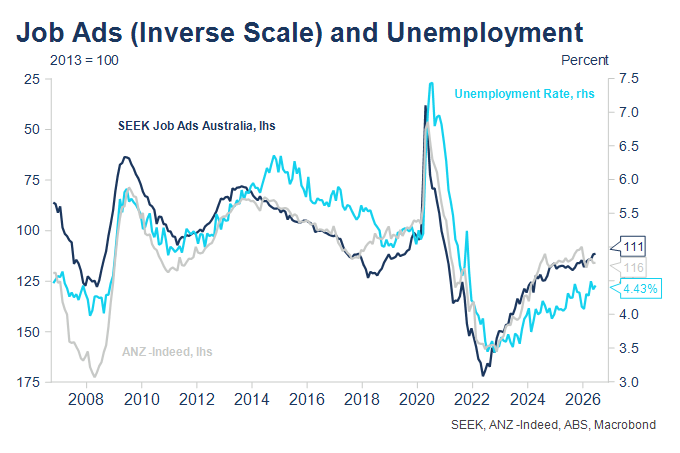
- I’m downplaying the message of last week’s apparently very strong Australian employment data, seeing this as largely reflecting sampling and/or seasonal volatility than true employment strength. SEEK job ads and the unemployment rate suggest a mild easing in the labour market is occurring, but are not signalling a sharp slowdown.
- This week’s June and June quarter CPI are expected to be slightly better than the RBA’s 1% Q2 forecast for the Trimmed Mean (market expectation +0.9% q/q and +3.7% y/y; previous +0.8% q/q and +3.5% y/y). Nevertheless, both the quarterly and annual prints are considerably above the RBA’s 2.5% inflation target.
- Of course, as the RBA has previously communicated, monetary policy can do nothing to prevent the current rise in inflation related to the Middle East conflict. The key is that policy settings are sufficiently restrictive to return inflation to target in a reasonable timeframe and prevent a broader rise in inflationary expectations.
- That’s the judgement the RBA and market must make in two weeks’ time based on this week’s CPI, the three tightening moves already enacted, and the lags in policy.
- The latest RBA Minutes appeared more hawkish to me than the market interpreted, though three of the big four banks changed their monetary policy outlooks ostensibly on developing house price weakness.
- Barring a shockingly high trimmed mean outcome for the June quarter (above 1% q/q), it’s unlikely that enough has changed in the economic or inflation outlook to prompt the RBA to tighten interest rates at its August Meeting. Given the lags in policy, it’s too early to expect much impact on the economy, while it would also be somewhat unusual for the RBA to tighten with house prices weakening relatively rapidly. That said, often during investment booms, house prices are weak because interest rates rise more than expected. My emphasis would be that house price developments reduce rather than remove the RBA’s hawkishness, and that further tightening later this year remains the more significant risk. This is now priced by Australian markets.
- The RBA Governor addresses the annual Anika Foundation lunch on Tuesday – it will be interesting to hear her latest thoughts and the Q&A as we approach the CPI and the August Board Meeting – while Assistant Governor Hunter conducts a fireside chat on Thursday, importantly, after the CPI data has been released.
Middle East developments
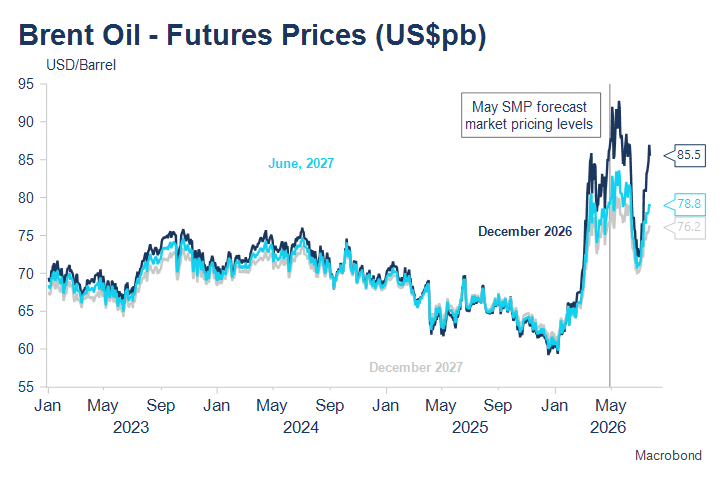
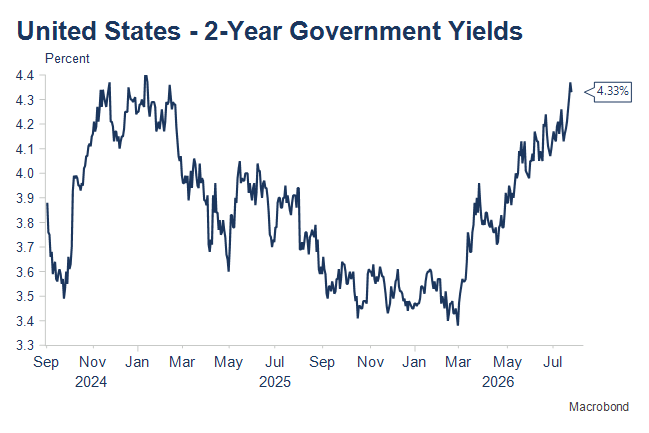
The renewed rise in oil prices has had a dramatic effect on Australian and US bond yields and monetary policy pricing, more so in the US, where of course the Fed has made no move to tighten monetary policy this year. Oil prices are now over US$20pb higher than two weeks ago, which has pushed US ten-year yields to the highest levels since early 2025. Attacks by Houthi rebels in the Red Sea, an alternative shipping route for Saudi oil, along with the all-but-effective re-closure of the Strait of Hormuz, raise the probability of more significant energy supply disruptions.
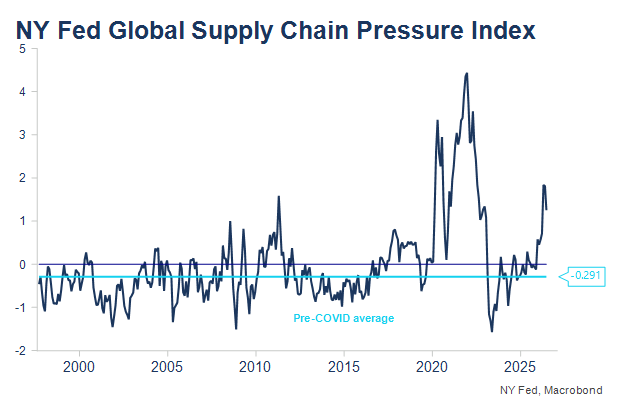
The latter have the potential to produce interruptions more broadly to economic activity as occurred during COVID lockdowns, though my prior is that the impact is unlikely to be as large or as widespread as when so much of the world was impacted by lockdown. The NY Fed’s Global Supply Chain Pressure Index currently supports that prior, though an extended period of disruption to such a large part of the globe’s supply may produce sharp dislocations in time.
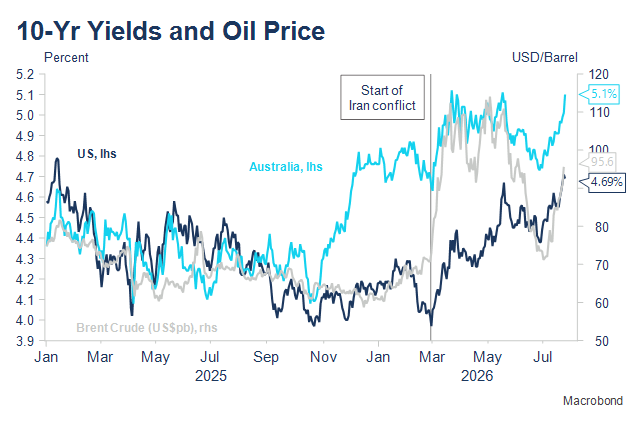
Oil prices have eased around US$3.80pb or 4.2% in weekend trading on IG Markets as there has now been a two-day lull in hostilities between Iran and the US. Futures prices nonetheless are reapproaching the highs of the conflict, importantly, as RBA staff put the finishing touches to the August Statement on Monetary Policy forecasts. Market pricing is similar to that assumed in the May SMP, where much lower prices appeared possible just two weeks ago. The longer oil prices remain elevated, the greater is the risk the higher costs become more broadly incorporated into general price rises and wage and price setting behaviours and expectations.
US and Australian short end pricing, the July FOMC Meeting and the previous Fed Minutes
The renewed rise in oil prices has brought about the repricing in US monetary policy expectations we have been looking for – and a bit more! While the market only rates an interest rate rise at this week’s meeting at just over a 33% chance, an increase at the subsequent mid-September meeting is now more than fully priced, the market factors nearly two increases by the end of the year and nearly two and a half 25bps rises are now priced at the peak (up from less than two such increases a week ago).
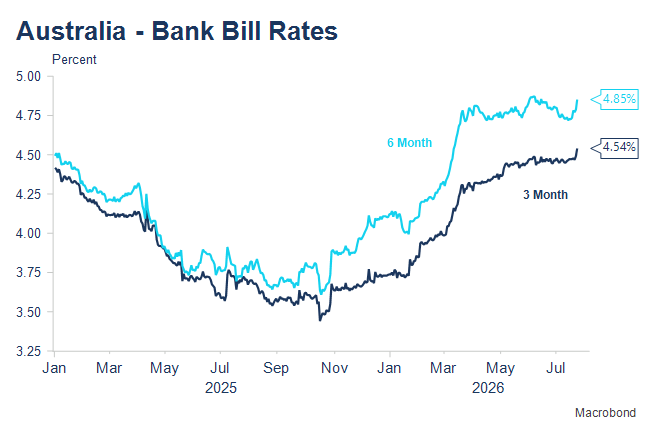
The change in US interest rate expectations, higher oil prices and Australia’s stronger than expected employment reading in June all contributed to quite a jump in Australian shorter-term interest rates over the week. Australian markets now fully price a rate rise at the November meeting but only attribute a 40% chance to an increase at the August Meeting in two weeks’ time and a 56% chance of a move by the Bank’s September Board Meeting. I expect the Board to continue to assess the impact of its previous tightening moves for some time, though the course of monthly inflation in coming months remains important.
The bond yield moves might seem a little surprising after the better than expected US June CPI release of last week, but a re-read of the following relevant sections of the June FOMC Minutes suggests the US economic and inflation scenario is developing along the lines of the second, more bearish scenario where “almost all participants indicated some policy firming would likely be warranted to return inflation to 2 percent”.
“Participants observed that inflation was elevated relative to the Committee’s 2 percent longer-run objective, in part reflecting price increases from supply shocks in certain sectors, including energy. Participants generally assessed that information received over the intermeeting period suggested that upside risks to price stability remained elevated while downside risks to achieving maximum employment had moderated a bit. A few participants commented that, in light of these developments, there was a case for raising the target range for the federal funds rate, but those participants indicated that they supported maintaining the current target range at this meeting. Several participants remarked that they did not see the current policy stance as restrictive, while a few other participants commented that they saw the current policy stance as slightly restrictive.
With regard to the outlook for monetary policy, amid high assessed uncertainty, various participants discussed a range of scenarios for the evolution of the economy and for future monetary policy actions. Most participants remarked on scenarios in which inflationary pressures would dissipate and inflation would soon begin to return to 2 percent. In such scenarios, almost all of these participants noted that it would likely be appropriate to maintain or eventually lower the target range for the federal funds rate. Most participants, however, also pointed to scenarios in which, in the context of stable labor market conditions, inflation would remain elevated due to strong AI-related demand, the conflict in the Middle East, or the effects of tariffs. In such scenarios, almost all of these participants indicated that some policy firming would likely be warranted to return inflation to 2 percent.”
The recently more closeted Warsh Fed, which has abandoned forward guidance given current elevated uncertainty about how things may play out, also means the market is more uncertain than normal about a potential move at this week’s FOMC Meeting. At 34% priced, the market reflects a narrow consensus that a move is unlikely at this meeting.
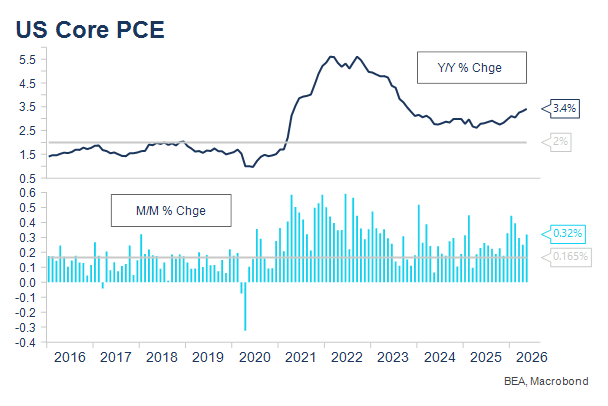
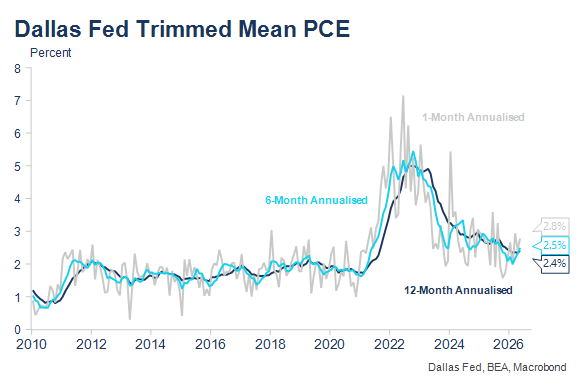
However, the components of the scenario described in the excerpts from the Minutes above requiring some policy firming are arguably all in play, though of course the Middle East situation was looking a lot less threatening only two weeks ago, a situation that could again change. That said, the longer oil prices remain elevated, the risk of those higher costs being passed more broadly into prices, rises. The core PCE remains well above target – and rising – though the Dallas Fed Trimmed Mean Inflation measure favoured by Chair Warsh, is less above target, though also rising. That’s a strong reason for considering a firming in policy relatively soon, though the much smaller deviation from target than during the pandemic – and very different inflation dynamics – suggest more moderate policy firming will be required. That said, there were further reports of forthcoming price rises in technology related products in the past week as the AI boom remains a source of demand-driven inflationary pressure.
The week ahead – Australian CPI and FOMC key along with ongoing developments in the Middle East and two RBA speakers
After a very quiet week, especially in the US, it’s a meatier calendar this week with the key June quarter CPI in Australia and the July FOMC Meeting and June PCE inflation reading in the US. The US also publishes its advance GDP estimate for Q2. There are appearances by two RBA senior staff members: the Governor speaks at the Annual Anika Foundation lunch on Tuesday, while Assistant Governor Hunter has a fireside chat on Thursday morning, importantly the day after the June and June quarter CPI data are published.
It seems increasingly likely that monetary policy will need to be firmed moderately in both countries, with only the timing an issue as inflation continues to run above target, more so in Australia than the US, though the RBA has already made three moves in this firming direction.
All times shown are AEST.
Tuesday 28 July
- 01:05pm RBA Governor Bullock Anika Foundation Speech
Wednesday 29 July
- 11:30am Australia June and June Quarter CPI
Thursday 30 July
- 04:00am FOMC Interest Rate Decision
- 04:30am Chair Warsh Press Conference
- 08:40am RBA Assistant Governor Hunter Fireside Chat
- 11:30am Australian Building Approvals, June
- 09:00pm Bank of England Interest Rate Decision
- 10:30pm US GDP, Q2
- 10:30pm US Core PCE Deflator
Friday 31 July
- 12:00-01:00pm (approx.) Bank of Japan Interest Rate Decision
Some brief comments on last week’s Australian labour market data
There was some questionable analysis of last week’s Australian labour market data, with the comment that employment surged due to increased participation the statement that most irked me. The causality flows the other way – with the measured stronger employment also reflected in higher participation. If lots of new people had suddenly decided to participate, it would be far more likely that the unemployment rate would rise rather than employers would suddenly expand workforces to accommodate them. The question around last month’s surprisingly strong 76,000 rise in employment is therefore the extent to which this reflects sample volatility, accentuated by seasonal adjustment mismatches and even the switch to new online sampling by the ABS in June which might reverse in July, or the extent to which it corrects for prior under-reporting of employment growth for the same reasons.
Likely, a mixture of these factors is at work, meaning one should downplay both the messages of sharply stronger employment growth and also sharp increases in the underemployment rate in recent months. The true trends for each will be revealed in coming months as the data settle.
In the meantime, I will rely on the message of SEEK job ads and the unemployment rate, though I do not consider the latter immune to some of the recent volatility in the labour force data. SEEK job ads have softened a little since February, mostly in May, but were broadly unchanged in June. They are signalling a mild softening in employment growth, rather than the surge that was recorded in the official June data, but do not suggest any sharp slowing. The unemployment rate drifted modestly higher in June at the second decimal place, also suggesting some moderation in Australia’s labour market. The RBA will often tend to favour the unemployment rate at times of significant volatility in employment data as the ratio tends to be less – but not completely (un) – affected by the factors creating the volatility in employment.