


Government changes to CGT strengthen the case for dividend paying shares. NATHAN HUGHES explains
- CGT changes penalise capital growth
- Dividends relatively more attractive
- Learn more about Perpetual Income Share Fund
Changes to capital gains tax are tilting the playing field towards dividend paying stocks rather than companies that reinvest earnings into growth, says Perpetual’s Nathan Hughes.
The Australian government has stripped away tax advantages for capital gains that have been in place for more than a quarter of a century and imposed a minimum 30 per cent tax on gains regardless of how much a taxpayer earns.
That means companies that pay out earnings as dividends rather than reinvest in growth now look like more attractive investments.
“They are changing the way income and capital growth are taxed. Capital growth is being taxed more,” says Hughes, who manages Perpetual Income Share Fund.
“But income hasn't changed – and you've still got the benefit of the franking credits as well.
“So, income will become a much more important contributor to your return going forward because of these changes.”
Higher demand for income
Hughes says the precise effect of the changes will depend on each individual investor’s circumstances but there is already evidence that investors are seeking exposure to income-paying stocks.
“We have seen a few listed investment companies with an income focus do capital raisings, and they've been well supported.
“We’re also seeing more interest from clients for the Perpetual Income Share Fund.
“And yields have compressed a little which is supportive of the idea that people are buying those sorts of stocks.”
The end of the popular high-yielding bank hybrid market is also driving the search for an alternative. New rules mean banks cannot issue hybrids from next year.
ASX income stocks
Hughes says the ASX has a range of strong, long established dividend payers that look attractive under the new tax rules.
He says investors should seek out quality businesses with the potential to grow dividends over time.
The potential for growth distinguishes equity income from investments that pay a fixed return.
“Some of the best investments we've made have been companies that have grown their dividend consistently over decades, and you see the compounding effect that has.
“You might start with a lower yield than the cash rate, but it’s a tax-effective yield because of the franking component – and that yield will grow over time.”
Dividends tend to be steadier than share prices, while companies capable of lifting payouts can provide investors with a level of protection against inflation, he says.
Soul Patts
Hughes highlights Washington H Soul Pattinson and Co (ASX:SOL), a diversified investment company with holdings across public, private and real assets. Listed in 1903, Soul Patts has never missed a dividend payment.
“Soul Patts is one of the longest-standing dividend payers on the market – and in recent years it has been growing dividends at 10 per cent per annum,” says Hughes.
“They pay dividends each year, but they also retain capital to grow their business. They have been doing that really well – and I think they can continue to do that for the foreseeable future.
“Investors that bought those shares have got a steady stream of growing income and built a passive income over time.”
Deterra Royalties
Hughes also points to Deterra Royalties (ASX:DRR), which holds a portfolio of resources royalties from commodities like iron ore, copper and mineral sands.
“It’s a royalty company with low costs – the cash just flows straight through to the bottom line, and the payout is really high to investors,” says Hughes.
“There's probably less growth ahead in the dividend, but it’s a high yield above 5 per cent, completely fully franked.
“You can build a portfolio of some high yielding stocks with less growth, and some lower yielding stocks with growth.”
Not all income is equal
Hughes says it’s important that investors take a careful selection approach to income stocks as a high headline yield can hide a poorly performing investment.
“We have all heard of value traps – but you can have yield traps as well.
“When dividend yield approach double digit levels and seem too good to be true, it is often a sign that there may be issues ahead.
“In our process, we look for dividend sustainability. The factors behind that are the earnings growth of the business, balance sheet strength, cash flow generation, and the payout ratio.
“Is the dividend being supported by cash flow? Is there scope for the payout ratio to grow over time?
“These are some of the things we focus on, as opposed to just going straight for the really high yielding stocks, because often that can be a sign of trouble in the future.”
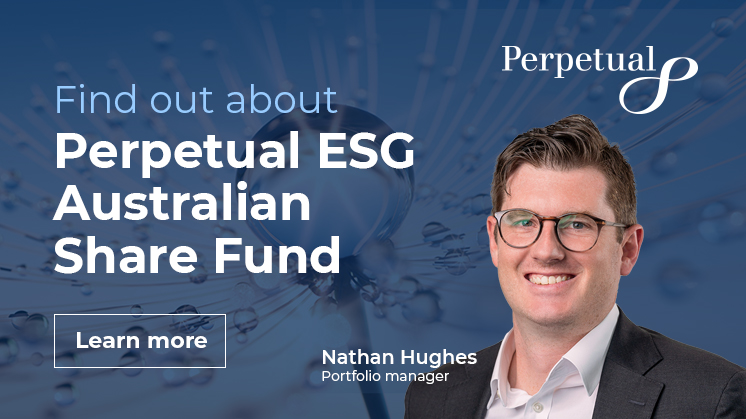
About Nathan Hughes and Perpetual ESG Australian Share Fund
Nathan Hughes is a portfolio manager with Perpetual’s Australian equities team. He joined Perpetual in 2010 and has more than 20 years of investing experience.
Nathan manages the Perpetual ESG Australian Share Active ETF (ASX:GIVE), including its unlisted share class, as well as the Perpetual Income Share Fund.
Find out about Perpetual ESG Australian Share Fund
Browse Perpetual’s Australian equities capabilities
Want to know more? Contact a Perpetual account manager

