


Recent events in Australia’s private credit market have placed a spotlight on a critical but often overlooked aspect of investing: valuation. Perpetual portfolio manager MICHAEL MURPHY explains the importance of actively assessing valuation.
- Valuation discipline helps private credit reflect markets
- External oversight strengthens transparency and investor confidence
- Find out about Perpetual’s credit and fixed income capabilities
Scrutiny of transparency and valuations within private credit markets have remained elevated over the year.
Alongside governance best practices emphasised by the Australian Securities and Investments Commission (ASIC), challenges faced by several high profile global private credit funds highlighted risks associated with credit quality and liquidity mismatch.
Michael Murphy, portfolio manager of the Perpetual Loan Fund, says when investing in private loans, issuer selection remains paramount.
“At Perpetual, valuation discipline is a cornerstone of the investment process,” he says.
“We continue to focus on large, quality Australian corporates with significant market share, economic moats and resilient recurring revenues.
“We also don’t participate in small to medium enterprises or property developer lending.”
Valuation transparency
Unlike assets that trade daily on public markets, many private credit investments require external assessment to ensure valuations accurately reflect prevailing market conditions.
This is particularly important during periods of market stress or heightened uncertainty, when assumptions can change rapidly.
There is generally less valuation uncertainty around performing loans to large corporates than around distressed assets or equity, but a robust process remains essential.
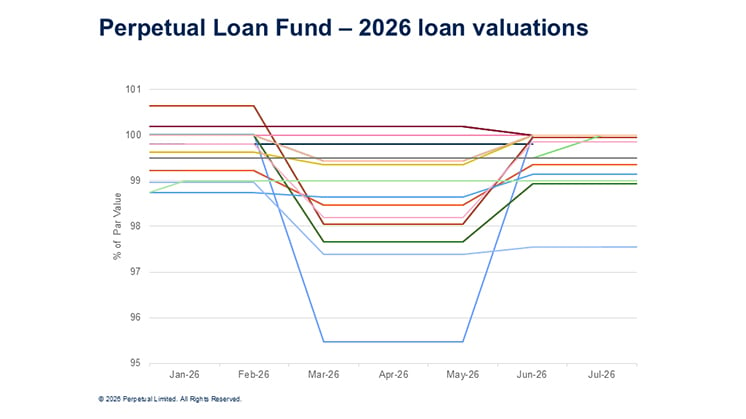
Perpetual utilises external valuation where portfolios hold illiquid private credit assets.
“Where external valuations are not publicly available, private loans are valued at least quarterly by IHS Markit, a division of S&P Global, with changes reflected in the unit price,” says Murphy.
This was evident when private loan valuations were marked down modestly in March following the commencement of strikes in Iran and the ensuing spread volatility, and subsequently revalued upwards in June as conditions stabilised.
The software sell-off amid concerns about AI disruption was another factor, with software holdings marked down the most to reflect declines in comparable listed companies.
The lesson from recent industry developments is clear: in private credit, governance and valuation frameworks matter just as much as headline yields.
At the end of FY26, the auditor of the Perpetual Credit Income Trust (ASX:PCI) scrutinised the valuations of the trust via an audit of the financial report.
PCI’s auditor gave an unqualified opinion, concluding the report gave a “true and fair view” of the trust’s financial position as at 30 June 2026 and its financial performance for the year.
Learn more on what to look for when investing in private credit: Private credit: Eight questions you should ask your investment manager
Hear more from Perpetual's Credit and Fixed Income team
About Michael Murphy and Perpetual’s Credit and Fixed Income team
Michael is a portfolio manager and senior high-yield analyst with Perpetual’s credit and fixed income team.
Michael manages Perpetual Diversified Private Debt Fund.
Perpetual offers a range of cash, credit and fixed-income solutions.
Our credit and fixed income team are specialists in investing in quality debt.
They take a highly active approach to buying and selling credit and fixed income securities and invest extensively across industries, maturities and the capital structure.
Learn more about Perpetual’s Credit and Fixed Income capabilities
Questions? Contact a Perpetual account manager

